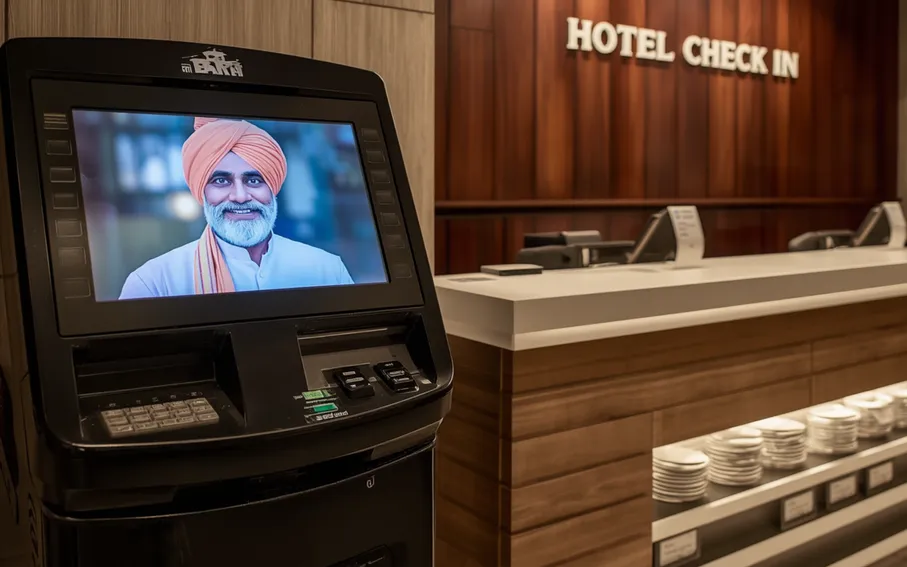
I checked out of a hotel in Half Moon Bay last week and spoke to no one. There was no clerk behind the front desk. No manager in the back office. No bellman, no concierge, no human being of any kind anywhere in the lobby. What there was, standing beside the empty front desk like a monument to the death of hospitality, was a machine—a large screen mounted on a kiosk that resembled a giant ATM. As I approached it, a disembodied voice emerged. A man with an Indian accent, clearly located thousands of miles away, appeared on the screen against a digitally rendered background that matched the wall art behind the vacant front desk—an AI-generated backdrop designed to simulate the illusion that someone was actually present in the building. He asked whether my stay had been good. I told him no and listed several specific concerns. He paused for exactly the length of time a script requires and said, "Sorry to hear that. You're all checked out, and you're ready to go." That was it. No follow-up. No offer to address the problems. No manager to speak with. No human judgment applied to a human complaint. I had been processed—not served, not heard, but processed—by a man on a screen who bore no relationship to the hotel, the town, or the experience I had just endured.

This hotel had once been privately owned and operated. It is now a Best Western. The brand acquired it and did what corporate hospitality always does: gutted the human infrastructure to cut costs while raising prices. The global hotel self-check-in kiosk market is projected to nearly double by 2032, reaching five billion dollars. The AI hospitality market is growing at over fifty percent annually. Hotels that adopt these systems report reducing front desk call volume by sixty to eighty percent and cutting operating costs by up to thirty percent. The industry celebrates these numbers as progress. What they actually represent is the systematic removal of the human being from the one industry whose entire purpose is to make human beings feel welcome.

The practical problems are obvious. A person on a screen cannot hand you a room key. This means the hotel must use electronic codes, which must be transmitted through some digital system—an app, a text message, an email. There is no printer at the kiosk. There is no pen or paper. If the code fails, there is no one to walk you to your room and open the door. If you have a physical item to return—a parking pass, a minibar key, a borrowed umbrella—there is no hand to receive it. If paperwork needs to be signed or a billing dispute needs to be resolved, the person on the screen can do nothing but apologize and direct you to a phone number that will connect you to another person on another screen in another country. The check-in process is even worse. Arriving at a hotel after a long day of travel, you want to be greeted, oriented, and made to feel that someone is glad you are there. Instead, you stand before a machine, scan your ID, tap buttons, and receive a code on your phone. You could be checking into a storage unit.

This post is for paying subscribers only

Sign up now and upgrade your account to read the post and get access to the full library of posts for paying subscribers only.

Sign up now Already have an account? Sign in