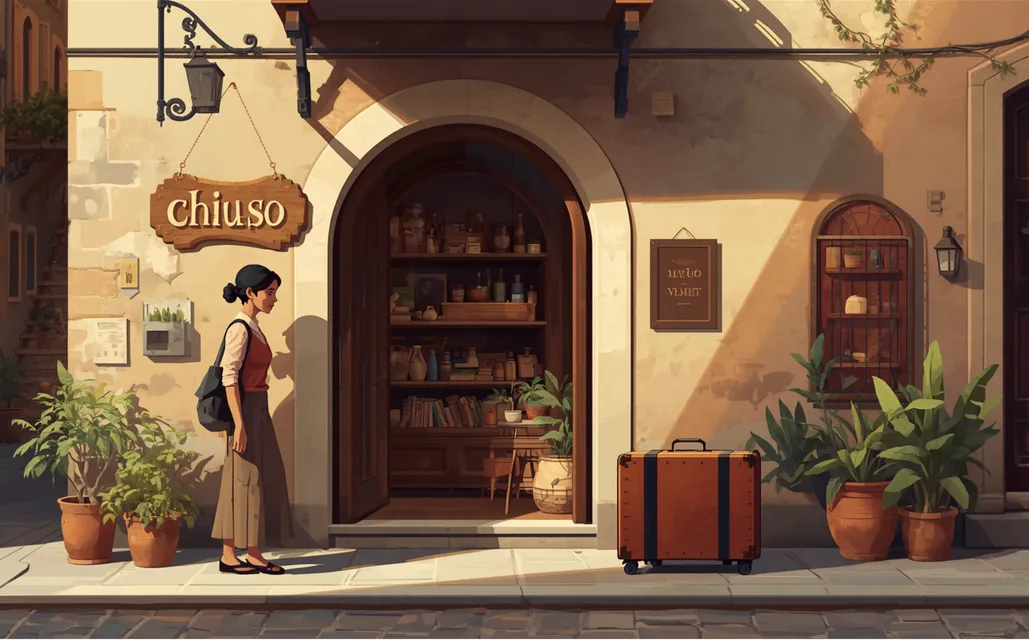
At ten minutes to six on a Saturday evening, I worked out that I had two hours to get a haircut or leave Sicily shaggy. I am in Santa Flavia for three more days. There are two barbers on the main street. Neither publishes a price. One lists no hours whatsoever — no website, no reviews, a telephone number and nothing else. The other, carrying five stars from a hundred and thirty customers, eventually yielded a schedule: open until eight that night, closed Sunday, closed Monday, and I would be gone by Tuesday. One window, two hours, and I learned none of it without digging. A man who lives here would simply have known. That is the entire problem in miniature.

The pattern repeats across every business with a public face. Gyms close Sunday and keep skeleton hours on Saturday. Barbers do not work Monday. Pharmacies shut on Sunday evening while every restaurant on the street is serving. A third of the restaurants close Tuesday and the rest close Monday, so that knowing the day tells you nothing. Most shops vanish for three to five hours in the middle of the day and then stay open until eight. No kitchen will put hot food in front of you before seven. A pastry shop opens at six in the morning, shuts at one, reopens at five, and on Sunday closes at eleven and does not open again until Tuesday. Wineries — wineries, in a region whose wine is its finest ambassador — advertise nine to six, seven days a week, and stand locked on Saturday and Sunday, the only days a visitor is free to come.

None of this is a technical failure. Every one of these owners carries a smartphone. Correcting the hours on a Google listing takes under a minute and costs nothing. Instagram is free. Artificial intelligence will write the post for you. The information is not withheld because publishing it is difficult or expensive; it is withheld because it has not occurred to anyone that a stranger’s afternoon is worth protecting. The sign on the door is not a promise. It is decoration.

This is the part outsiders misread as disorganization. It is not disorganized at all — it is a system, and it functions beautifully, provided you are inside it. If you are the nephew, you send a text. If you are the neighbor, you know the man takes Monday because he always has. Opening hours are not information here; they are a relationship. For everyone else they are a wall, and the wall does real work: It keeps the customer base local, familiar, and small. A business that can only be used by people who already know the owner has quietly fixed a ceiling above its own head and called it tradition.

This post is for paying subscribers only

Sign up now and upgrade your account to read the post and get access to the full library of posts for paying subscribers only.

Sign up now Already have an account? Sign in