Something essential has been lost in American life, and most people cannot name it because they have never experienced it. It is not a program. It is not a policy. It is not something that can be legislated or funded or downloaded onto a phone. It is the simple, irreplaceable experience of being among other people in a shared public space—not for a purpose, not for a transaction, but for the elemental human need to see and be seen, to hear and be heard, to rub against the rough edges of strangers and come away changed. American cities have abandoned this. They have traded the enclave—the vibrant, walkable city center where life actually happens—for a sprawl of asphalt, drive-throughs, and isolation. And the cost has been enormous.

Consider Los Angeles. It is the second-largest city in the United States, and it has no center. There is no place where the city converges, no square or plaza or promenade where the stockbroker and the artist and the immigrant and the retiree cross paths by accident and are forced to acknowledge one another’s existence. What Los Angeles has instead is a conglomerate of balkanized baby centers—Silver Lake, Venice, Koreatown, Brentwood, Highland Park—each one a self-contained ecosystem that looks inward to confirm its own prejudices and biases. These neighborhoods interact very little with one another. A person can live in Los Feliz for a decade and never set foot in San Pedro. The result is not diversity. It is segregation by preference, a city of parallel lives that never intersect.

This is not unique to Los Angeles. Even smaller American cities have suffered the same fate. The old downtowns—the ones built around courthouse squares and main streets and corner drugstores—have been desiccated and displaced by artificial suburban centers anchored by corporate megalopolises. Walmart. Target. Indoor shopping malls with identical storefronts selling identical products under fluorescent lighting that could be anywhere in the country and therefore is nowhere in particular. These places are designed for consumption, not connection. No one lingers in a Walmart parking lot to debate the merits of a local school board candidate. No teenager falls in love at a strip mall. No elderly man finds a reason to leave his house because the big-box store two miles down the highway is calling to him. These are not gathering places. They are processing centers. You enter, you purchase, you leave. The car takes you from the home to the edifice and back again. That is the whole of American social architecture.

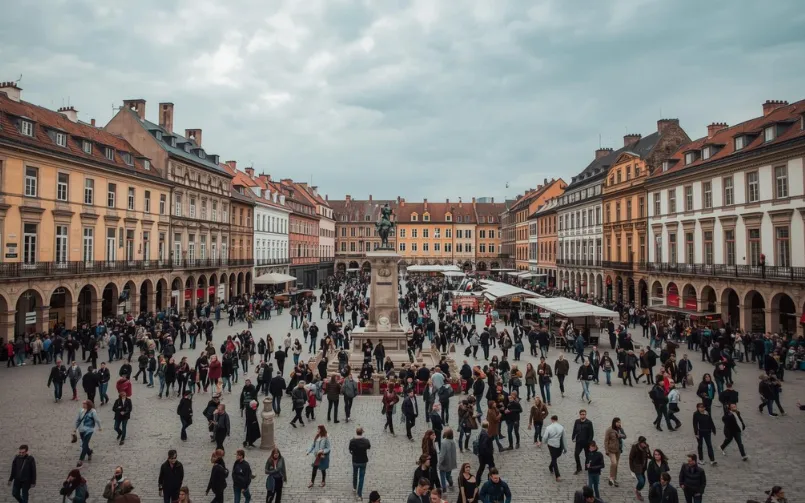
Now consider a different model. Walk through the center of Kraków, or Ljubljana, or Tbilisi, or Wroclaw, or Budapest. These cities were built hundreds—in some cases, thousands—of years ago, and their design reflects something that American urban planners have either forgotten or never understood: People need a place to gather that belongs to no one and therefore belongs to everyone. The city center in Central and Eastern Europe is not a relic. It is a living organism. The outdoor marketplaces that once defined these spaces may no longer operate in their original form, but the center remains—dominated now by coffee shops, restaurants, public performances, and, in most cases, a church. Culture, religion, and social life for young and old continue to occur in a natural setting that is adaptive to contemporary life but rooted in the historical traditions of that city and nation. A twenty-year-old student sits at a café table next to a seventy-year-old pensioner. A street musician plays for a crowd that includes businessmen, tourists, mothers with strollers, and teenagers skipping school. No one planned this. No one funded it. It simply happens, because the space was designed—centuries ago—to allow it to happen.

This post is for paying subscribers only

Sign up now and upgrade your account to read the post and get access to the full library of posts for paying subscribers only.

Sign up now Already have an account? Sign in